Showing posts with label Movie Review. Show all posts

Thursday, November 26, 2009

The Informant! Movie Review

Unbelievable is Right - The Film is Informative But Flawed


The Informant!


Movie Review


I wonder how the pitch for this movie went. Steven Soderbergh, director of Ocean's 11 through 13, bowls into the office of a besuited studio executive, ready to give the lowdown on his latest feature project. It turns out that the Academy-Award winning director wants to adapt a book called The Informant, written about price-fixing in the lysine industry. The suit nods along as Soderbergh discusses his plans; he's thinking of The Insider, and how that film, although lauded by critics, didn't perform too well at the box office. This movie is going to need something different, something extra. Almost on cue, Soderbergh says the same. The suit is impressed, until he hears that the director wants to make a dark comedy. That's when the nodding stops.


The Informant! tells the story of Mark Whitacre (Matt Damon), who outed a worldwide lysine price-fixing ring in the mid nineties. He confesses one night to an FBI agent (Scott “Quantum Leap” Bakula) who has been brought in to work on an unrelated extortion case. This is unusual in itself because, first of all, the agent didn't know a thing about the conspiracy, but also because Whitacre had a lot to lose from co-operating (he was the highest-ranking whistleblower in US legal history, and was swiftly ascending the company ladder when he confessed). As the agents spend time with their inside man, they begin to find that he has problems of his own, and is not as squeaky clean as he appeared at first blush.


Let me cut straight to the nub of what's wrong with this film; the third act sucks a donkey's nether regions. The first hour or so of the movie trundles along nicely. I was sucked into the plot pretty early and it was holding my interest, despite the fact that the jokes weren't exactly flying. Matt Damon's take on Mark Whitacre is quietly endearing, and his voice-over asides are the most enjoyable element of the film. The small man taking down a big company dynamic was floating my boat, and I was engaged, if not ecstatically overjoyed.

Then the movie fell apart. Whitacre is exposed as a fraudster who has been battling with bipolar disorder, and the focus of the film shifts from his battle with his employer, to a personal fight to keep a grip on reality whilst avoiding prison himself. It's all introspection from there to the credits; in one easy step the forward thrust of the plot stalls, and Whitacre goes from lovable weirdo to pathologic liar.


I'm convinced that the reason Matt Damon is such a good actor is because he seems like he would be a blank slate off camera. He seems to have an uncanny ability to slot the fragments of his personality into whatever character he is currently portraying. I wholeheartedly believe that if I were ever to meet the man in real life, he would speak like a robot.


Soderbergh does his usual slick job here. He seems to have a knack for picking unusual projects, and making them more than they appear on paper; exactly what a good director should do, I suppose. Between the two of them, director and leading man have synthesised a similar comedic style to the Ocean's movies, all pauses and music cues. It works well, and softens the eventual drop-off.


Go to see this movie if you're hard up for unwatched new releases, but be aware, everything from the beginning of the third act is a shocking waste of time. You have been informed.


6/10


Thursday, November 12, 2009

The Men Who Stare at Goats Movie Review


The Men Who Stare at Goats


Movie Review


I am rarely tricked by trailers, which, apart from being the worst superhero power of all time, is also a handy money-saving device when deciding which films to go see. So, when I saw a snippet of The Men Who Stare at Goats about two months ago, I was quietly delighted, because it looked like it contained all the elements necessary to make a good film. Oh, how wrong I was. The trailer for this piece of foulness was my shiny green kryptonite.


I read Jon Ronson's book – on which the movie is based – a few years back, and really enjoyed it, although never did I think that it had any hope of becoming a feature property, mostly because of its documentary style. The book concerns Ronson's efforts to find out more about a section of the U.S. army which were in training to use highly specialised and exceedingly secret parapsychological skills, such as – I s&*% you not - invisibility and walking through walls. You can see where this is going; Ronson spent a great deal of The Men Who Stare at Goats presenting an army unit which was misguided at best, at worst insane. The title comes from what the soldiers – who call themselves Jedi warriors - did in an attempt to try to stop the hearts of what must have been some very confused animals.


The movie essentially steals the premise of the book and throws in a plotline in which a reporter (Ewan McGregor) goes to Kuwait during the Gulf War, where he bumps into a Jedi warrior (George Clooney), who takes him into occupied territory. And then hilarity ensues, right?


Not exactly. What unfolds over the course of the film's extremely long-feeling 90 minute runtime is a string of pratfalls, sight gags and verbal jokes so hackneyed and unfunny that they would make the orangutan from Dunston Checks In blush. This movie is a textbook case of stocking the trailer with all the best bits; blatently misleading advertising. God knows how the producers of this movie managed to convince stars like Kevin Spacey and George Clooney to sign on, but I wish that I had their powers of persuasion if nothing else.


On the cast; I don't know whether the director knew who Ewan McGregor was before, after, or during the film, but he had quite a prominent role in the prequels to a moderately successful franchise known as Star Wars. I couldn't work out whether the writers – by including frequent mentions of Jedi warriors - were just beating the joke to death, or if they just couldn't be bothered to change dialogue once McGregor became attached to the project. The first time Jedi was mentioned, there was a nice ripple of laughter in the audience, and I found myself grinning, but a joke like that grates so easily and by the fourth time around I began to anticipate it as much as nails on a black board.


Jeff Bridges also deserves dishonourable mention, playing Bill Django, founder of the New Earth army. His role is basically a badly written version of The Dude from The Big Lebowski, and I was quite hoping his eventual death would be a lot more graphic.


Do yourself a favour; use your powers of mental persuasion to convince yourself that this movie was never made. And if you want to see the American military being made fun of, watch Dr. Strangelove.


1.5/10

Wednesday, November 4, 2009

Fantastic Mr. Fox


Fantastic Mr. Fox


Movie Review


Filmmakers are increasingly using animation to make adult-oriented movies. No, not pornography; these directors and writers are subverting a genre typically seen as exclusively pre-adolescent by inserting grown-up themes and humour. Pixar does it all the time, and kids lap it up because their computer-generated animation is well executed and cool things occur in abundance. The latest offering to exploit this “kids love shiny things” loophole is Wes Anderson's Fantastic Mr. Fox.


Mr. Fox (the wonderfully dry George Clooney) is enticed out of his profession – raiding local farms – by his wife's declaration that she is pregnant and becomes a writer for the local paper. But, after two years of family bliss Fox opts to move to a house – well, a tree to be more precise – overlooking the properties of three of the area's biggest farmers. A series of night time sorties follow, and eventually Fox – and his woodland neighbours – must deal with the consequences.


I wouldn't really describe Fantastic Mr. Fox as a return to form for Wes Anderson, since I really enjoyed both The Life Aquatic and The Darjeeling Limited; rather, the movie is a return to commercial viability for a director who needs a hit more badly than a strung-out junkie. Both of Anderson's last two features floundered at the box office, and if Fox goes the same way, there could some wilderness years ahead for the young auteur.


I get the very strong feeling that certain members of the cast were heavily “suggested” to Wes Anderson. The two leads – Clooney and Streep – are stars that can justify the $50 million budget, but neither is included for the sake of a big name. Clooney has grown a reputation as an actor that can deliver a nuanced performance which won't dissuade audiences from coming to see him, and brand Streep - revitalised following 2008's Mamma Mia – is character acting for the masses.


The script, penned in conjunction with The Squid And The Whale's Noah Baumbach, is dryly-humoured dynamite, but not quite fit for consumption by those yet to grow pubic hair. One particular scene, which I can only assume was written by Baumbach - whose Squid relates to the breakup of his parents – sees Mr. Fox admit to Mrs. Fox that he cannot not control his impulse to do an Ozzy Osbourne impression on farmyard chickens. Mrs. Fox's reply to this is that she knew this when they wed; her solution, they should never have married. The scene ends there, with no pratfall or fart noise to break the tension. We're in the land of animated reality here, people.


Speaking of which, the inert sets mirror Aardman's Wallace and Gromit constructions. Their stillness accentuates each character's movement, which was reportedly mimed for the animators by Wes Anderson. They are often filmed from distance too, adding to the sense of dreamy stillness.


The Fantastic Mr. Fox proves that you don't need Pixar computer trickery to produce a slick, funny, and above all fantastic, adult-family film.


9.5 out of 10

Wednesday, October 14, 2009

Zombieland Movie Review


Zombieland


Movie Review


By Alan Del Rio


George Romero has a lot to answer for. Over forty years after Night of the Living Dead reignited interest in a previously formulaic genre, the zombie horror film is still taking a bite out of global cinema box offices. Romero's 1968 film was subversive at the time – featuring a black hero who survives the zombies, but is killed by a redneck posse – and is still inspiring young filmmakers to have a go themselves. Zombieland is the latest take on the genre, and its about as fresh as a film featuring rotting corpses can be.


Set in a post-apocalyptic, zombie infested world, Zombieland follows a small group of survivors as they search for a small, safe patch of land to call their own. Pretty much par for the zombie owned, controlled and operated course so far, right? Well, what sets this film apart is the imaginative, hilarious script, a cast that extracts every last iota of humour, drama and action from same, and snappy direction from newcomer Ruben Fleischer.


I must admit that I had a hard time settling into the movie. The first five minutes, including credits, are more reminiscent of an eighties hair metal music video than a feature film. But, when the cast finally hit the screen, and lead character Columbus (all of the characters go by Pelham-like aliases – in this case their home town) outlines his rules for surviving a zombie holocaust, the movie begins to gain some momentum.


Zombieland is decidedly “new zombie”. It eschews Romero's shuffling, slow-moving undead in favour of the hyper-fast (and scarier) Zack Synder variety. The soundtrack is filled with the heaviest of metal, and all of the characters have adjusted to their decaying environment like the urban badasses they are. This last fact slightly undermines the menace which the zombies should possess, as mostly they are fodder for humourous set pieces, but the film never completely castrates their rotting unmentionables, and they play a key role in the unnerving finale.


The cast, only consisting of four main characters, and one unexpected, side-splitting, movie-stealing cameo, is immense. Woody Harrelson gives his funniest performance since White Men Can't Jump, as the tough but yielding Tallahassee, whose sole purpose is to find earth's last edible Twinkie. Jesse Eisenberg is fast developing a niche as the guy you get when Michael Cera is busy. He provides the everyman character to Harrelson's rampaging Tallahassee, and his rules form the linchpin of the movie.


Emma Stone and Abigail Breslin are terrific as the con artist sisters. Believable and above all funny, they add a welcome extra layer of conflict between the human characters. Now, how do I talk about the cameo without giving away that it's Bill Murray? Oops. Murray arrives at the midpoint, when the main characters stay in his house, and although he is only on screen briefly, he single-handedly drags the film through the usual second act slump. Best cameo I have seen since Will Ferrell in Wedding Crashers or Anthony Hopkins' brief appearance in Silence of the Lambs.


It's not all good news though. I was, at times, left wondering why certain creative choices were made, mostly because I was disappointed that a team which had gotten so much right had managed to drop the ball at all. For instance, Fleischer seems to adhere to the music video school direction, all décollage and slow motion action. And while this works well for the most part, it does occasionally draw attention to itself, which is a cardinal directing sin. Additionally, although the script is by far my favourite element of the movie, the semi-frequent voice overs are just plain lazy storytelling.


In an interesting (define interesting – ed.) aside for any movie trivia heads reading this, the reason for the breakdown of civilization in Zombieland is a form of human adapted mad cow disease. This form of infection is borrowed, whether intentionally or by coincidence, from the 2004 Irish zombie film Dead Meat, which is worth a closer look if you can find it on DVD. Yet again Irish ingenuity shapes the face of modern film making. That's why we're called “the Hollywood of Europe” (I'm pretty sure that's a lie - ed.).


Zombieland is funny, scary, savvy, tense, and above all ass-kickingly cool. All excellent reasons to go see it, but there is one thing above all else which makes me recommend this film; you've got to love a movie whose tag line is Nut Up or Shut Up.


4 out of 5 stars


Monday, September 28, 2009

District 9 Movie Review


District 9


Movie Review


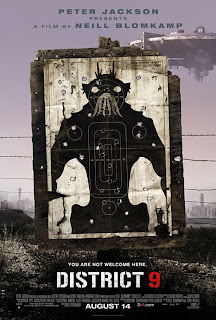
Remember THAT scene in Alien? John Hurt laughs and enjoys a drink with his crew mates, little realising that he has taken part in the sci-fi world's answer to the Deliverance. Suddenly, a fetal alien bursts from his chest to wreak it's acid-soaked wrath upon the surviving inhabitants of the Nostromo. It's one of those cinematic images that melds itself to the frontal lobe, like the shower scene in Psycho or the Statue of Liberty reveal in Planet of the Apes; quite hard to forget. Now, cast your mind back to what Alien did for science fiction heading into the eighties, giving the old Star Wars paradigm a much needed hug in the facial department. Well, the naughties now have their own version of that genre busting whip-livener in the shape of District 9, a rending tale of alien xenophobia set in a post-apartheid South Africa.


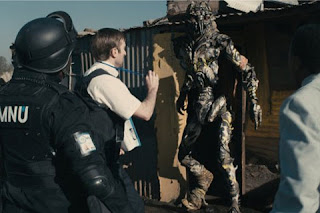
The documentary-style narrative follows Wikus van de Merwe, an employee of MNU, which is a private contractor to the South African government. As the movie opens, he is celebrating a recent promotion, having been given control of an illegal alien camp relocation. This is where this version of earth's reality skews of from our own, as the aliens in this camp come from a little further afield than other African nations. They are intergalactic refugees, having been stranded when their mammoth spacecraft stalled over Johannesburg roughly twenty years before the events of the movie. There are no signs of intelligent life on board, and the working-class lifeforms inhabiting the ship need to be cut free and extricated.


Their less than hospitable hosts place the alien creatures in temporary accommodation which quickly becomes a run down slum. The life forms (“Prawns” as they are derisively called – you can see why from the above picture) don't do themselves any favours either. They're generally uncouth; eating raw meat and cat food, and stealing from the local population to fund their prodigious consumption of same.


Now, Wikus is a nice guy. He has a wife (who, honestly, is far too hot for him), and is a pretty happy go lucky chap. But he's under immense pressure to clear the camp from his father-in-law, who got him the job. Additionally, he seems to have little or no regard for the prawns, and treats them with a lack of humanity. All that begins to change though when he is sprayed by a strange liquid during a routine search of a prawn shack.


District 9 started life as a short film, developed by director Neil Blomkamp. He was in the process of developing his first feature film, an adaptation of the Halo video game series with [LOTR-link] guru Peter Jackson, when the project was shelved for lack of financing. Instead, they chose to develop the short, originally entitled Exile in Joburg, into a full length movie.


The film itself draws from different sci-fi and horror tenets. Part Blair Witch shockumentary, with a little David Cronenburg body horror mixed in, it uses small parts of these genres to quickly and compactly build its complex and engaging plot. The first two acts are spring loaded with so much exposition and action that it is a testament to the quality of the script to say that the pacing never feels ragged or jarring as they rapidly unwind.


Sharlto Copley is eminently engaging as Wikus. His initial gleeful mistreatment of the Prawns can be put down to negligent disregard rather than malicious intent, and his arc is perfectly judged, so that there is some real visceral emotion behind his eventual suffering and retaliation. It also doesn't hurt that he sounds like an inner-city Dubliner when he shouts FOOK - copiously - throughout the movie.


The production design and special effects seem to have been sourced in part from another video game, namely the Half-Life series. I would be interested to see what Weta Workshops list of inspirations was, especially for the Prawn battle suit, whose gravity weapon bears more than a passing resemblance to Half-Life 2's gravity gun.


I cannot fault a little cribbing though, because the effect of the Weta treatment is to add enormously to the scale of District 9. I walked out of the movie theatre estimating that the production, with all of it's explosions, alien creatures and giant floating spaceships must have cost in excess of $100 million dollars to make, when a paltry $30 million was the actual expenditure.


It is a sad truth that there will be no major Oscar wins for District 9. Science Fiction films don't tend to go home with many statues. The most it can hope for is a Best Special Effects and Best Original Screenplay nomination and maybe a nod in the Best Foreign Film category. Where this feature will ultimately stand or fall is in the money it makes (already $126 million at the global box office). But, on the evidence of what I have seen here, District 9 deserves to rake in more coin than Raymond Babbitt at a blackjack table.


9/10


Tuesday, September 22, 2009

Inglourious Basterds Movie Review


Inglourious Basterds


Movie Review


Having done his version of a heist movie, blaxploitation flick and revenge drama, Quentin Tarantino's latest film is a World War II epic with a difference. A war movie told in the filmic language of the spaghetti western, Inglourious Basterds is a quick return to directing for QT following Death Proof's disappointing reception. But whether it is as good as film's past is a debate I'm ill equipped to lead.


I saw Inglourious Basterds ten days ago. And after ten days of mulling, evaluating and considering, I have yet to form a strong opinion on Tarantino's latest offering. I like it, damning as that sounds, but beyond that tepid sentiment I'm still as unsure as I was when I left the cinema. I know it's not de rigeur for someone who fanices themselves a film critic to say - or type - this, but before I can be more sure about this film I think I'll need to see it again on DVD.


The narrative follows a small group of American soldiers dropped behind enemy lines in an attempt to disrupt and sabotage Nazi operations. Or as Brad Pitt's character, Aldo Raine says “we in the killin' Nazi business. And cousin, business is a-boomin'”. A subplot follows Shosanna Dreyfus, a French Jew who finds herself owning a cinema in Paris after the execution of her family by SS officer Hans Landa (Cristoph Waltz). The paths of these two sets of protagonists begin to coalesce when they find themselves in positions to bring the war to a premature conclusion.


I think the primary reason I didn't get to grips with Inglourious Basterds is that I can't decide whether it crosses the line into self-indulgence. Actually, it's not so much self-indulgence as a lack of tightness in the script. The opening scene is a prime example of this. The scene itself, involving a French farmer and Hans Landa, is stocked to the hilt with tension and suspense, but takes an oh-so rambling route before docking at it's resolution, teetering on the brink of flabbiness throughout.


I would have preferred if the movie concentrated solely on the Basterds, because their initial antics and unveiling was where the movie peaked. No sharp decline follows, but the moody and unenthralling Shosanna segments would have been better left on the writing room floor in favour of more Inglouriousness.


However, the plot does take enough Tarantino-esque left turns to still periodically lift the movie into better than good territory. The final ten minutes are a revisionists wet dream, and when an interrogation scene turns deadly the urge to shut at least one eye is hard to resist. Narrative structure apart, the director's usual calling cards litter the screenplay. Movie-reference studded dialogue (in the form of Leni Riefenstahl name checking and a discussion of Chaplin's The Kid), fetishistic shots of female characters feet, and an increasingly vivid streak of cruelty which the director seems to harbour towards his creations make themselves apparent throughout the production. Never one to hold back on unleashing bodily claret, Tarantino must have felt like he was back on the set of From Dusk 'til Dawn at times.


As usual though, the director's aural sensibilities are faultless. The music is exquisite, and opens up the vista of a movie mostly shot indoors. And even if it a large portion of it shouldn't belong in a WWII-era movie, you're left wondering why it wasn't attempted before, which is exactly as it should be with a Tarantino production.


Cristoph Waltz deserves most credit for imbuing his SS Colonel with the spirit of a devilish Sherlock Holmes, a role which landed him the best actor award at Cannes and a role in the upcoming Green Hornet. Brad Pitt is in usual fine fettle as the leader of the Basterds. It's already been proven, but endlessly worth repeating that he is as adept with comedy as with drama, and can gear change seemlessly between the two. Eli Roth (he of Hostel directorial infamy) is similarly engaging as Donny Donowitz aka The Bear Jew. In a casting mis step, Mike Myers cameos as a British General. I just couldn't take the SNL alum seriously as a non-shagadelic Brit.


Maybe I had a better handle on this movie than I thought. Inglourious Basterds is middling Tarantino; certainly not as good as his early work, but head and shoulders above vast swathes of his contemporaries. Ah, nothing like a good – scratch that, above average – review to clear the mind.


7.5/10


Tuesday, September 8, 2009

Son of Rambow Movie Review


Son of Rambow


Movie Review


I have begun to become aware that a lot of the movies I review for my blog receive high scores. With the exception of last month's Public Enemies, I generally haven't disliked too many of the film's featured. This is not necessarily because I am a soft reviewer, but more a function of the fact that I generally don't go to see flicks starring talking chihuahuas. Maybe if I were a paid critic (hint hint, any major publications out there) I would be required to watch whatever was voided from Hollywood's bowel in any given week. But until that day arrives, I see what I want. With this in mind, and in the interests of broadening my range of synonyms for the word mediocre, I thought I would review a movie which I have seen recently, one that didn't necessarily line up all the cherries in my mental slot machine.


Son of Rambow is a movie which received positive reviews upon release in 2007, but for one reason or another, I never saw during it's theatrical run. Directed by Garth Jennings (who also helmed the rather spiffing Hitchhiker's Guide), it seemed – not to sound too similar to a film poster - like a good natured romp. The story centres around two boys growing up in the eighties, one a little too bad, one a bit too good. Will's a timid young boy. His father is dead and his family is part of the Plymouth Brethren (which the film portrays as though it were the British branch of the Amish religion). Lee's absentee parents live outside the UK, leaving him and his self-obsessed brother alone most of the year. With no parental controls Lee has devolved into, for want of nicer language, an over-confident little shit. When he decides that he needs a stuntman for an amateur film he is trying to produce (based on Rambo: First Blood), he emotionally blackmails Will into taking a few for the team, and, in time-honoured movie fashion, an unlikely friendship begins to flower.


I almost wish I hated this film, then I would have some feelings towards it. As it is, indifference is the only emotion I feel for this middle of the road, coming of age comedy. Son of Rambow is innocuous, sometimes entertaining screen-filler, but measured against the film's of the late great John Hughes – in the genre which he defined – it doesn't even reach ankle height.


Why so downbeat? Well, film's of this nature aren't too hard to get right. You start off with two archetypal characters, the nerd and the cool kid. Throw them at each other for what audiences like best – conflict. Somewhere in the course of the second act, the nerd begins to become popular, whether through association or his own strength of character – and the cool kid gets jealous. Cool kid causes large event (X) which puts their friendship in jeopardy, in the course of which he learns a little nerdish humility. Throw in a third act resolution of situation X, during which our bespectacled youth gets to show off his new found worldliness and bish bash bosh, you're out. So far Son of Rambow has all the boxes ticked. Oh, but there is one more thing; your film needs to different enough from what has come before to avoid boring an audience to death.


It is at this last hurdle which Son of Rambow not only falls, but suffers a fontanelle-busting arse over head tumble. The story is pure dullsville. There is nothing noxious here to ruin a mildly good time, but similarly no flashes of brilliance to lift the film above mid-table mediocrity. The strict-religion-ruining-a-good-time story line was done a lot better in Footloose and that was over twenty years ago. Here it is trotted out as a faded copy. Most annoyingly though, I have seen the unlikely friends plot strand played out in every film from Fox and the Hound to Rain Man, so if I'm to sit up and take notice of a new entry in the log book, it had better be damn good. That was decidedly not the case here. Lee's hard exterior buckle's under the weight of Will's good natured innocence all too forgettably. I have had more impression left upon my mind by a late-night trip to the bathroom.


The lack of laughs in Son of Rambow is it's next problem and is confusing, as the story provides ample berth for a much sharper, more contemporary sense of humour (even given it's temporal setting). Instead, the film sets up the characters and begins to plough an obvious and unchanging comedy furrow with each. The worst example of this is with the French foreign exchange student character, a good concept, the execution of which is wasted on a plethora of similar gags which quickly become boring, and eventually mind numbing.


Finally, and most damningly, there comes the unengaging plot. This robs the movie of all but a watch-it-out-of-the-corner-of-your-eye-while-doing-the-ironing appeal. The best of this genre of film have a sort of last day of term feel to them, and leave an audience with a palpable sense of relief when the main characters achieve their objective. The third act of Son of Rambow does not steadily build towards a endorphin-releasing crescendo, but instead changes the parameters of the leading character's needs in an unsatisfying way, robbing the audience of their long-awaited payoff.


There is a saving grace of sorts though. The movie's heart is in the right place. The relationship between the boys, while trite, does seem emotionally real. The two young actors playing Will and Lee (Bill Milner and Will Poulter), are to thank for this. They spark off each other to provide some life at the centre of an otherwise barren story.


You could do worse than perhaps catching Son of Rambow on satellite or terrestrial TV when it eventually wends it's way that far, but for now find yourself a dark room, the collected works of John Hughes, and experience the real thing.


4/10


Tuesday, August 25, 2009

Wedding Crashers Movie Review

Wedding Crashers


Movie Review


Wedding Crashers is the film that shifted the adult comedy paradigm. Before it was released industry hacks were convinced that adult comedies couldn't do numbers in the upper echelons. Wedding Crashers took in $285,000,000 worldwide during its big screen run, and is a major part of the reason why films like The Hangover are getting made.


The outline is one that could fit onto the back of a postage stamp, or be displayed on a grain of rice, such is it's simplicity. Friends John (Owen Wilson) and Jeremy (Vince Vaughan) are wedding crashers. Thats not a Cronenburg-type sexual fetish which demands they drive their cars into wedding receptions and have sex in the ensuing carnage. Rather they turn up uninvited to weddings and, using a combination of bravado and research into the wedding party, bluff their way in. All is going swimmingly until they attend the nuptials of the daughter of US Treasury Secretary William Cleary (played by Christopher Walken). In the act of trying to sleep with the bride's two remaining sisters, the boys endear themselves to the family a little too well, and are invited to the post-reception get together at the family home. By this stage John is falling in love with Claire Cleary (Rachel McAdams) and Jeremy is falling decidedly out of lust with her sister Gloria (Isla Fisher in a career-making role). The two feuding friends must wend their way through a minefield of inappropriate grandmothers, creepy brothers and dangerous fiances if they're both to get what they want from this particular crash.


Wedding Crashers is in my top five films of the last five years. There, I said it (or to be more accurate, wrote it). Not The Squid and the Whale, not Dark Knight, not most of the multitude of equally deserving high concept movies put to market in the last half decade. An adult oriented, sometimes - well, if truth be told, mostly - crude comedy ranks in the highest percentile of films I have viewed since 2004. And the biggest reason why is because it is infinitely watchable.


The term Desert Island Discs is thrown around all too much when it comes to music, but there doesn't seem to be an equivalent for film. Never is an interviewed director asked to imagine themselves as a castaway on part of a remote archipelago, with nothing but time to kill and a small selection of movies to watch; his Desert Island Digital Versatile Discs if you will. What would he choose, and what would be the criteria for those choices?


It is my opinion that one criterion should be that any film chosen should be capable of being viewed multiple times without self-induced hair loss. Its all very well to say that you like, for instance, last year's Aronofsky classic The Wrestler, but that's really a once-every-five-years movie at most. Any more than that will require a trip to the pharmacy to fill a prescription for some powerful anti-depressants.


Some directors consistently produce films that are endlessly watchable. Stanley Kubrick was one such man. On average I watch a Kubrick film once every six to nine months, that timeline only being elongated by the fact that his films don't regularly pop up on TV; not regularly enough anyway. While I no longer think that a string of Kubrickian gold will flow from David Dobkin's directors chair (2007's Fred Claus put paid to that fantasy), I do think that he – along with newcomer screenwriters Steve Faber and Bob Fisher – have accomplished something that most filmmakers never do in crafting a movie which I take time out to watch every time it appears on TV. Add to that the fact that its repeatedly being pulled from my DVD collection and I must have seen it at least fifteen times in the last four years.


Why? Well, the story for starters. Faber and Fisher have plotted a cleverly coarse tale of two crashers, featuring well realised – if a little unsubtle - characters, a killer plot, and machine-gun dialogue packed with the same level of quotable gems as a Golden Era Simpsons episode. A film's IMDb quotes page doesn't get to be this long by pure chance. Whats more, the popularisation of the verb “Motor Boat”, at least in my mind, can be traced directly back to this flick, and praise doesn't come much higher than when a movie manages to insert a new phrase – however boorish - into the public consciousness.


The wonderful cast features three frat pack alumni; Owen Wilson, Vince Vaughan and a cameo by Will Ferrell. While both Wilson and Ferrell have their moments this is Vince Vaughan's movie. He doesn't really stand out from surrounding performances during the first act. The reason for this is that his character is on the same page as Wilson's. However, once his fellow crasher starts demanding extra time with his quarry, and unsuspectingly dropping his buddy into some compromising situations in the process, Vaughan's quick-fire sarcastically disgruntled delivery comes good and the second act winds up being the best of the three.


If you still hanker for more, then this Commandment-like crasher's rulebook makes good reading. Meanwhile, one thinks one shall retire to the island TV cave with a dry martini, a copy of the movie, and a book on outboard engines.


9/10

Sunday, August 23, 2009

Good Will Hunting Movie Review


Good Will Hunting


Movie Review


Close your eyes and open up your mental landscape; I want to spin a little scenario for you. You go in to buy petrol on your way home from work and notice that they sell lottery tickets. You've never bought one before, but decide that it might be fun to have a bit of a gamble with your spare change. So you shove the ticket in your pocket and promptly forget about it. Until three weeks later that is when you discover it and find out that oh, you've just won the rollover jackpot. That must have been how Matt Damon and Ben Affleck felt when Good Will Hunting came out. Their first attempt at writing a script and, besides winning an Oscar, it turns out to be one of the best and most watchable movies ever written, launching über-successful careers for both.


Luck only goes some way to accounting for the success of this movie; the talent on display here – acting, writing and directing – is what carries the boys' freshman effort far over the line. Some critics though had a hard time ascribing the necessary screenwriting chops for such a critical and box office success to two young unknowns. Rumours surfaced that Affleck and Damon hadn't written the movie themselves, and that William Goldman – Screenwriter of Butch Cassidy and Marathon Man amongst others – had helped. The degree of this help varied depending on the source consulted, with some suggesting that Goldman had ghostwritten large chunks of material. When grilled, Goldman did admit that he had been consulted, but said that he merely provided direction, nothing more.


Misdirected furore aside, what do we have here? Good Will Hunting is the story of a self-taught polymath from South Boston. Will Hunting (played by Matt Damon) works as a janitor in a local university, and in his spare time hangs around with his friends (Ben and Casey Affleck). An altercation between the group and some old enemies lands Will in court, not for the the first time. He's saved though by a professor in his university (Stellan Skarsgard), who has seen Will's proof of a particularly difficult mathematical problem which he posted for his students and wants to work with him. In return for not receiving a custodial sentence, Will must also see a psychiatrist (Robin Williams).


The cast do a phenomenal job, and its the newcomers lead the charge from the front. Matt Damon is involved and involving as Will. He changes gears between vulnerable, sarcastic, charming and intellectual without missing a beat, and occupies his screen time with the aplomb of a twenty-year acting veteran.


Godd Will Hunting showcases Ben Affleck as an audience may never see him again. The actor, in his pre-leading man, post-mallrats (where his character liked to have sex with girls in an uncomfortable place) phase is eminently humorous and vitriolic but ultimately endearing as Will's bestie Chuckie. On the strength of this performance alone I'm willing to go on record with Kevin Smith as having a man crush on the future half of two Beniffers (coincidentally, Smith gets a co-producer credit with his long time collaborator Scott Mosier for bringing the film from Castle Rock to Miramax in turnaround). The scene where he explains to Will that he'll beat the shit out of him if he's still hanging round Southie in ten years is both the peak of the flick and Affleck's performance.


The Matt Damon besotted Minnie Driver shows that although it may be hard on your off-screen life, falling in love with your co-star produces a scintillatingly genuine performance (her best to date by a rather large margin). Even Casey Affleck gives a nod to the acting potential which he is now fulfilling.


The old guard aren't to be outdone by the newbloods though. Stellan Skarsgard puts on his usual dynamic clinic as fields medalist Gerald Lambeau. If there were a stanardised movie knowledge IQ test which posed the following question: Best Robin Williams film of the eighties is to Good Morning Vietnam as best Robin Williams film of the nineties is to ____________, the answer would be Good Will Hunting. He's more World According to Garp than Patch Adams in tone (which is good – very good), but with Garp's rougher edges refined. Add to this a squirt of the world weariness of a man who's been through the same tribulations that he hears from his patients and you've got one of the most memorable psychiatrist-patient relationships in motion picture history. He's nearly as good value for his Best Supporting Actor Oscar as the boys for their Best Original Screenplay statue.


Even though its hard to miss during viewing, none of the buffalo was wasted on this film. Do you ever watch a really good movie but maybe once or twice it throws up scenes that just feel a little off? The film is still very watchable, but you can't help but notice a bit of downtime in between where the story planes off at a slight tangent and where it rejoins the meaty part of the plot. Well, that was a feeling I didn't during the watching of this film, and some credit for that must go to the director, Gus Van Sant. Recently becoming a two-time best director nominee for Milk, his first came for this piece.


Fair enough, you have to put it in perspective; with material like this you probably could have filmed the actors giving their lines against a white background and the end product would have had a modicum of success, but Van Sant adds some much needed legitimacy to the fledgling script and film makers. His direction doesn't need to perform any tricks to augment the film. What it does do though is call attention away from any of the screenplay's adolescent blemishes by providing the right visual. Its filmed in a manner which posits that all the locations and characters have been around for years, but oh, you've just happened upon them now? What good timing, well let me show you this. The film even avoids the characteristic mid-movie slump, and I can't think of many which pull that feat off. How do you like them apples indeed.


If you haven't seen this movie, see it, and if you didn't like it first time around, watch it again, and again until you realise how impossibly wonderful it is. And, while you're watching, if you still don't get it, just tell yourself that its not your fault. Its not your fault. Its not your fault.


9.5/10


Thursday, August 20, 2009

Public Enemies Movie Review


Public Enemies


Movie Review


Some filmmakers never learn. Unfortunately, the same goes for some filmgoers. The last Michael Mann movie I went to was Miami Vice, and I began nodding off about halfway through that; something I almost never do, and certainly not, as in that case, during an action scene. I recently saw Public Enemies, and promptly began dozing about half an hour into this turgid period gangster piece.


So, what was wrong? Nothing for the first five minutes or so. The film opens with John Dillinger (Johnny Depp) breaking what comes to be his gang out of Indiana State Prison. Its a nice tight, exciting opener, made better with some well chosen camera shots (one in particular stands out – a gorgeous wide shot with Depp at its centre which pans with his movement to reveal the prison as backdrop).


Unfortunately, the film fails to reach the foothills of that involving opening again, wasting its not inconsequential running time on cliché dialogue and plot and a toothless, uninteresting storyline. There was obviously far too much attention paid to creating the elegant 1930's depression-era setting and not enough time put into crafting a well-oiled script.


The movie is based on a non-fiction book about bank robber John Dillinger's life, written by Bryan Burroughs and turned into a screenplay by, among others, the film's director Michael Mann. Burroughs praised the writing saying that, “it's by far the closest thing to fact Hollywood has attempted, and for that I am both excited and quietly relieved.” Well Bryan, don't speak too fast because scripts have a tendency to look good on paper if nowhere else.


I remember the exact moment when I went from thinking that the film was salvageable, to wondering about the mental capacities of the scriptwriters. Its about twenty minutes in and after the decent opening, the pace is beginning to slow, and the romantic interest in the form of Billie Frechette (Marion Cottilard) makes her appearance. As much as it sounds like a Human League lyric, Billie is working as a coatcheck at a cocktail bar when Dillinger meets her. Billie doesn't go for Dillinger at first though, and is just about to give him the bum's rush when an impatient customer starts haranguing her. Dillinger decides that the best way to deal with this gent is to give him a severe beating in front of the young lady. Why not, sure he's not doing too well anyway. Best to get his sexual aggression out here rather than the bathroom back home, right? But the camera switches to her, and oh yes; Frechette absolutely loves it, and agrees to see Dillinger again. Bang went my suspension of disbelief, and any goodwill had built up in the leading characters. From that point out Frechette deserves what she gets for shacking up with Dillinger, who is a madman, and an uninteresting one to boot. You can pull the curtain there and then because I don't care about the outcome anymore.


The cast in Public Enemies is all over the place. Depp gives a soulless performance as Dillinger. Now, the guys a bank robber and sociopath, so going down the “no soul” road is a good acting choice, but Depp is an actor who needs his bag of tricks to engage the audience; thats why Pirates of the Caribbean worked so well. If John Dillinger had a British accent, wore effete clothing, or had scissors for hands, then Depp might have shone, but as he had nothing on which to peg it, his performance flounders. Cottilard is passable as Frechette, even if the premise of her character's involvement is ludicrous, along with her dialogue with Depp (the "I'll protect you" lines are laughable). Christian Bale gives his usual brooding turn, regardless of what the role calls for, and as ever adds as much top lip overhang as audiences can stomach. There are some performances worth waking up for though; Giovanni Ribisi (who should be getting more high profile roles than guest spots on My Name is Earl) is engaging as Alvin Karpis and Billy Crudup, fresh off playing Doctor Manhattan in Watchmen, does a nicely judged J. Edgar Hoover.


It seems that Michael Mann is going to Lucasian lengths to ruin his really quite respectable reputation as a crime drama director. Manhunter and Heat are two of my favourite movies, and now I have to pay money to watch this shaky camera bollocks? Why? I would not have been surprised – and it probably would at least have made me take notice – if a Jar-Jar-esque Jamaican gangster had been slotted into Dillinger's gang, spouting dialogue like “Whassa Missa Dillinga? Weesa gonna hold up a bank? Yousa thinkin' yousa people gonna die.”


No doubt Mann will be back. Hollywood forgives a lot when you've made a movie like Heat; and Public Enemies has somehow managed to make double it's budget during it's theatrical run. But hopefully next time, before sitting down to a script, he will look to the tenets which made that film such a critical and popular success. And then refrain from doing the opposite.


1.5/10